
In 1957, a psychologist named J. C. R. Licklider spent part of his spring and summer trying to find out how he spent his working hours. He had found surprisingly little research on the mechanics of intellectual work, so he decided to study himself.
Keeping records of what he did was threatening to become a major part of what he did. He simplified the experiment and eventually arrived at a rather disconcerting figure. About 85 percent of his thinking time was spent getting into a position to think.
On one occasion, he wanted to compare the results of six experiments on the intelligibility of speech in the presence of noise. The researchers had used different measures of speech-to-noise ratios. It took him several hours to make their results comparable and a few seconds to find out what he wanted to know.
He also realized that the inconvenience of doing such work influenced the questions he chose to investigate. Presumably there were things he would have liked to know but never bothered to find out.
Computers could have done much of the arithmetic. The trouble was that he seldom knew in advance what arithmetic he would need done.
In 1960, Licklider published a paper called Man-Computer Symbiosis. He wanted a computer he could work with while he was figuring things out. He pointed out that when we give instructions to another person, we can often get away with specifying only the goal. With computers, we generally had to specify the procedure as well.
It’s worth considering how early in the history of computing he was writing. FORTRAN had been in use for only three years, and even the idea that computers could produce efficient machine code was a relatively recent achievement.
When John Backus and his colleagues at IBM started developing FORTRAN, many programmers doubted that a compiler could produce code as efficient as the code they wrote by hand. Earlier attempts at automatic programming had given them good reason to be sceptical.
Computer time was expensive. Saving a programmer a day’s work was of questionable value if the resulting program took considerably longer to run every time it was used.
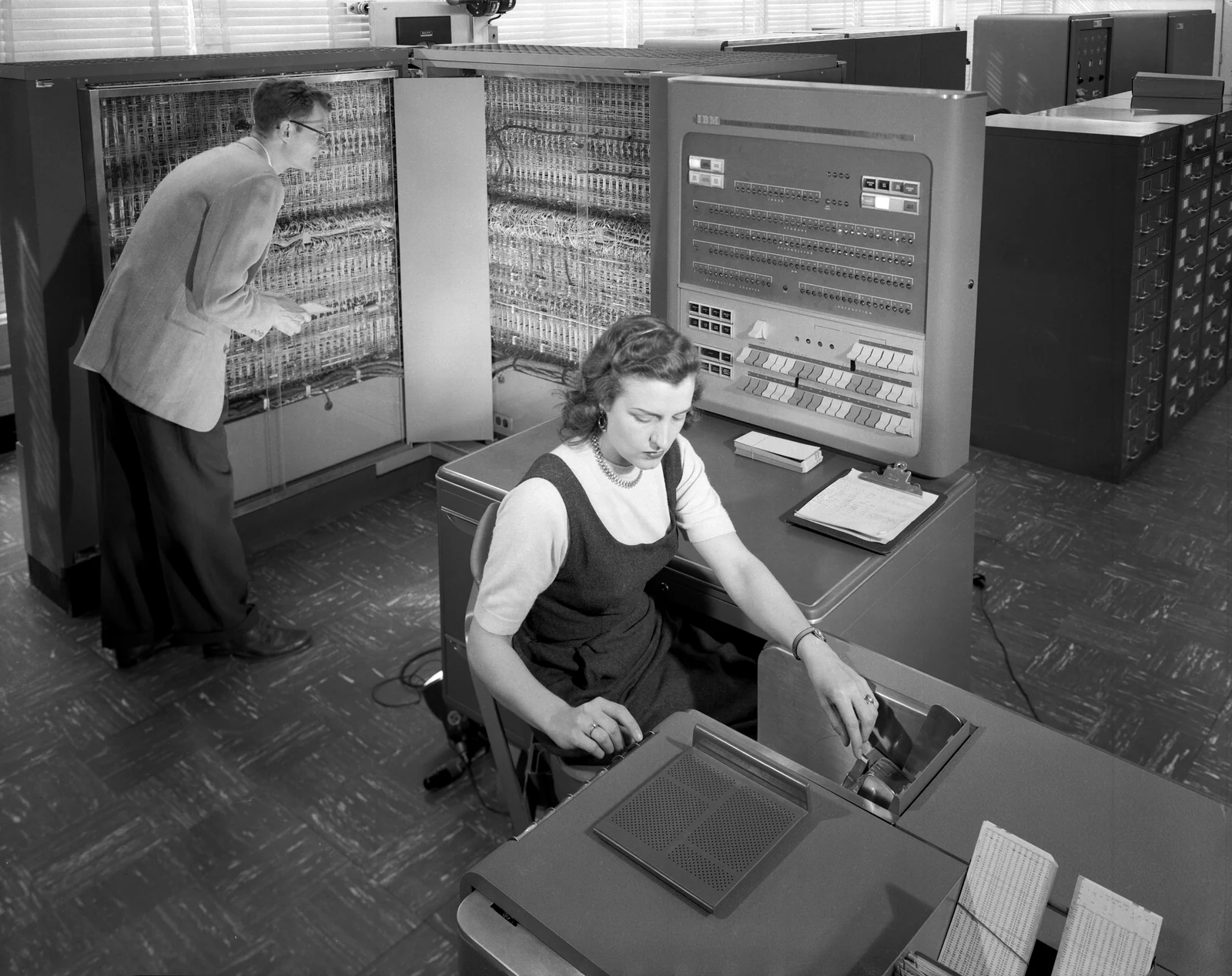

Backus and his colleagues succeeded in incorporating much of the expertise of an assembly programmer into a compiler. A programmer could express a calculation in something resembling mathematical notation and leave the selection of machine instructions to the computer.
But someone still had to know what to calculate.
Licklider was interested in getting beyond that limitation. So was John McCarthy, who in 1959 published a description of a proposed program called the Advice Taker. McCarthy wanted to be able to tell a computer things, in a formal language, from which it could deduce what to do.
The two researchers had quite different ideas about how to accomplish this. What I find remarkable is that computer scientists had barely got computers working before they began to think about how to relieve people of the necessity of working out exactly what the computers should do.
We’ve been pursuing versions of that idea ever since.
The developers of SWE-agent have published an account of their coding agent investigating a bug in Marshmallow, a Python library used to convert data between different representations. A user had discovered that when converting a particular time interval into milliseconds, the library returned 344 instead of 345.
The agent puts the example code from the bug report into a file and runs it to reproduce the error. It examines the library, modifies its implementation and runs the program again. This time it gets 345. Before submitting its changes, it deletes the file.
A programmer investigating the same bug would probably have done something similar. We write little programs all the time to examine log files, compare data and test suspicions about the behaviour of other programs.
We don’t think of ourselves as developing a software product on each of these occasions. We’re simply making use of one of the most useful tools a programmer has: the ability to write a program.
It’s a tool that most computer users haven’t had at their disposal.
Suppose someone in a company’s accounting department discovers that the revenue reported by one application doesn’t agree with the figure produced by another. Neither application has a function for explaining the discrepancy. Someone will probably spend a good part of the afternoon exporting data, moving things between spreadsheets and comparing individual transactions.
A programmer might write a script to do much of this work. But there’s nothing inherently technical about wanting to know why two numbers disagree. The need for a programmer arises from the limitations of the software available to the person asking the question.
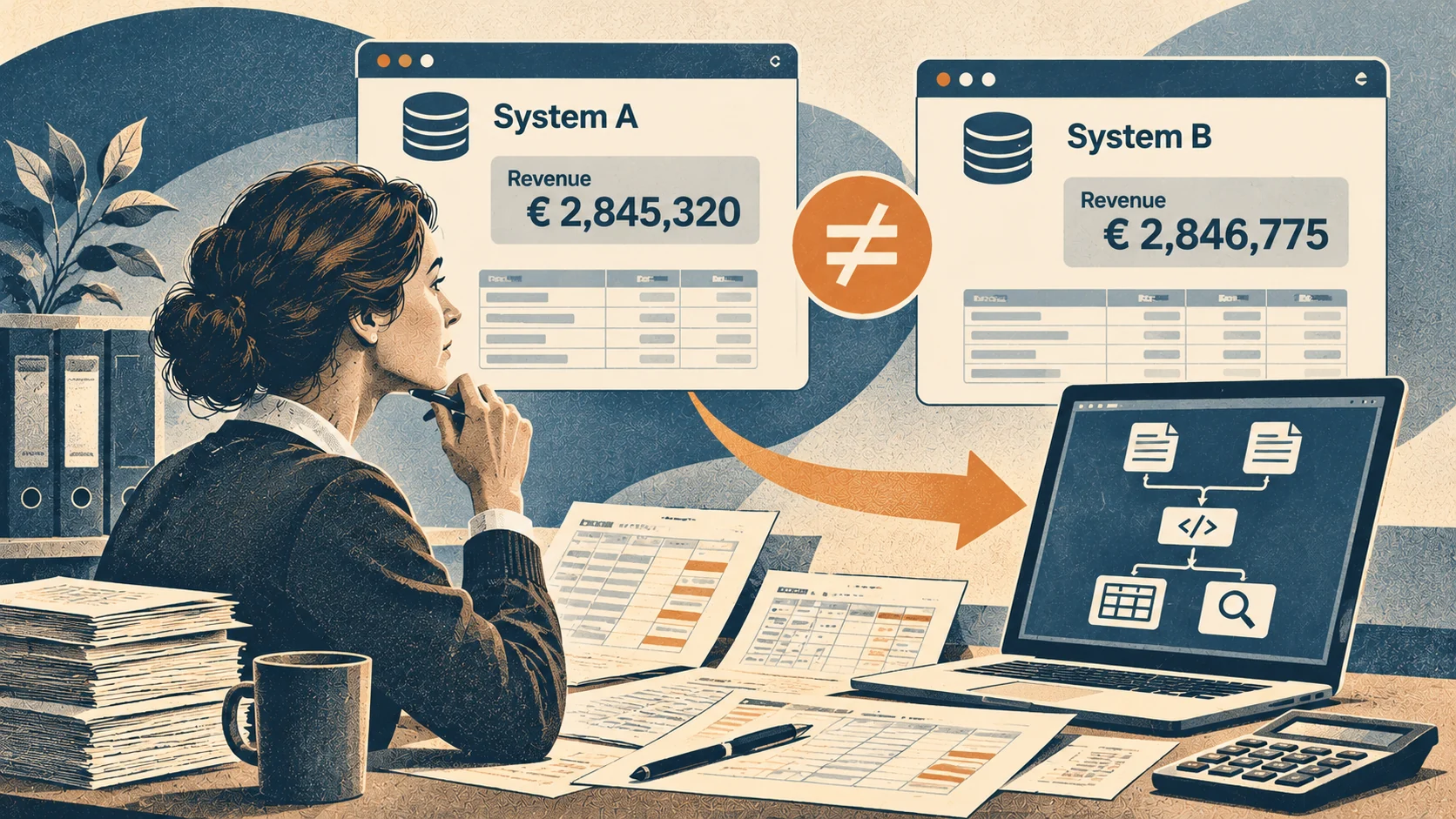
In 2025, Cloudflare and Anthropic described a way of giving AI agents access to something resembling the toolkit a programmer would use.
An agent might have tools for retrieving invoices from an accounting system, obtaining sales records from another application and searching documents. It can call these tools and decide what to do on the basis of what they return.
With an approach known as code mode, it can also write programs that use the tools.
In our accounting example, the agent could write a program to retrieve records from both applications, match transactions and calculate the differences. If the results suggested that some transactions were being counted twice, it could write another program to investigate.
Nobody would have had to develop a reconciliation feature for these particular applications beforehand.
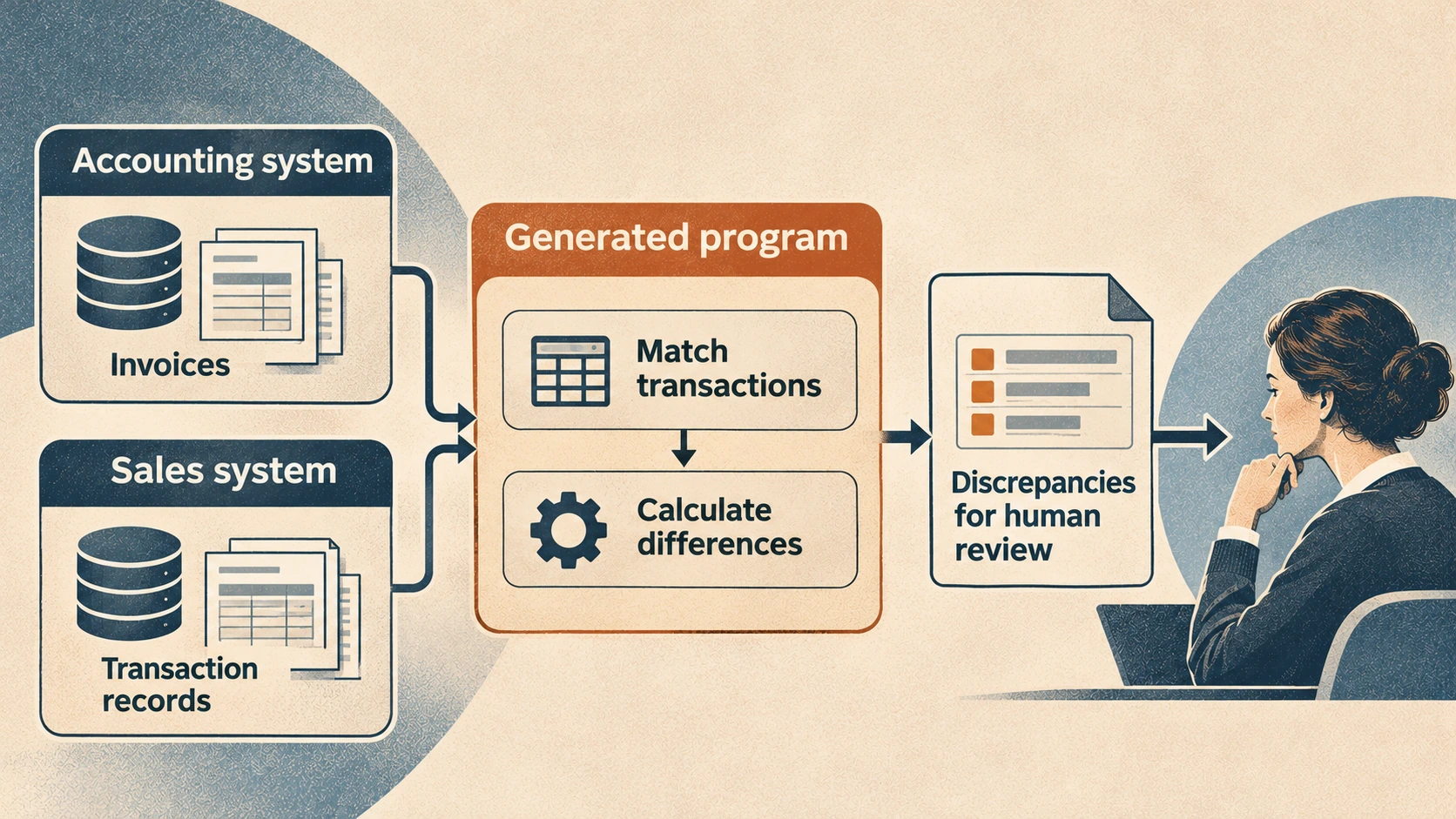
One reason for introducing code mode was efficiency. There’s little point in having a language model examine several thousand records if a few lines of code can extract the relevant ones.
But something else has happened in the process. Programming has become one of the means by which the computer goes about answering the user’s question.
Licklider contemplated something remarkably similar in 1960. He imagined assembling programs from collections of existing routines as the need arose, rather as we construct sentences from words and phrases.
It took more than sixty years to develop a mechanism that could attempt to do this across a wide range of tasks in response to the sort of request one might make to a colleague.
There are limits, of course, to what a colleague can do for you.
In his 1987 essay No Silver Bullet, Fred Brooks argued that much of the difficulty of developing software lay in deciding what it should do.
Our accounting example illustrates the problem. The agent might discover that the two departments use different definitions of revenue. It can write as many programs as it likes, but the question of which definition the company ought to use is for the people in the company to settle.
What the agent can do is save them some of the work involved in discovering that there’s a question to be settled.
Licklider would have appreciated the difference.
I wonder how much of what we regard as the nature of software is actually a consequence of how difficult it has been to produce.
We tend to think of software as something that has to be developed, tested and delivered before it can be put to use. For a great many purposes, that’s still exactly how it should be done.
But a spreadsheet has always offered a somewhat different model. Its developers couldn’t possibly have foreseen all the calculations its users would want to perform. They provided a collection of functions and a means of combining them, and left some of the programming to the users.
An AI agent could extend this sort of flexibility to people who wouldn’t know how to write a spreadsheet formula, let alone a program. Given suitable tools and permissions, it could also combine the capabilities of several applications.
This might change the way we design those applications. We’d still have to get the individual operations right, enforce business rules and make sure the programs generated by the agent could be checked. But we might spend less time trying to anticipate all the particular things people would want to do with them.
If Licklider had those six sets of experimental results today, he could ask a computer to make them comparable. With a little luck, it would work out the necessary calculations, write a program and run it. He’d still have to satisfy himself that the comparison made sense.
Whether the program was used once or a thousand times would be of little interest to him. He was a scientist trying to find something out. The program would have been one of his instruments, like a calculator or a piece of laboratory equipment.
For most of the history of computing, we’ve been trying to make it easier for people to write programs. I suspect what Licklider really wanted was to make programming available to people who were trying to do something else.
We’re beginning to see what such a computer might look like.
References
- Licklider, J. C. R. (1960). Man-Computer Symbiosis. IRE Transactions on Human Factors in Electronics, HFE-1(1), 4–11. Online full text.
- Backus, J. (1978). The History of FORTRAN I, II, and III. History of Programming Languages conference. Publication and DOI. IBM publication record for the 1979 reprint.
- McCarthy, J. (1959). Programs with Common Sense. Proceedings of the Symposium on Mechanisation of Thought Processes (held in 1958), National Physical Laboratory. Online paper (PDF).
- SWE-agent project. Trajectories. Project documentation, example execution trajectory involving Marshmallow. Online execution trace.
- Cloudflare (2025, September 26). Code Mode: The Better Way to Use MCP. Cloudflare Blog. Online article.
- Anthropic (2025, November). Code Execution with MCP: Building More Efficient Agents. Engineering article. Online article.
- Brooks, F. P., Jr. (1987). No Silver Bullet: Essence and Accidents of Software Engineering. Computer, 20(4), 10–19. Online full text.

0 Comments